TESA & PESA Treatments
Overcoming Azoospermia: Biological Fatherhood Through TESA & PESA
A semen test showing zero sperm (azoospermia) does not mean that sperm are not being produced. In both obstructive and non-obstructive cases, viable sperm are frequently present directly inside the testicular or epididymal tissue.
At Jabalpur Hospital Embryology & Laparoscopy Centre, led by Dr. Devkriti Tiwari Dhirawani, we provide advanced, minimally invasive surgical sperm retrieval techniques: TESA (Testicular Sperm Aspiration) and PESA (Percutaneous Epididymal Sperm Aspiration). Performed in a gentle daycare setting under local anesthesia without open surgical incisions, these procedures harvest viable sperm that are immediately paired with ICSI micro-fertilization to achieve your biological pregnancy.
90% to 95%+
Obstructive Success15 to 20 Min
Painless DaycarePaired ICSI
Single Sperm Injection100% Private
Dignified Comfort
TESA (Testicular Sperm Aspiration)
Direct needle aspiration of seminiferous tubules within the testis. Ideal for non-obstructive azoospermia with focal spermatogenesis, or post-vasectomy patients when epididymal sperm is insufficient.
PESA (Percutaneous Epididymal Sperm Aspiration)
Aspiration of fluid directly from the epididymis using a micro-fine needle without incisions. Best suited for obstructive azoospermia (congenital absence of vas deferens, infection, or prior vasectomy).
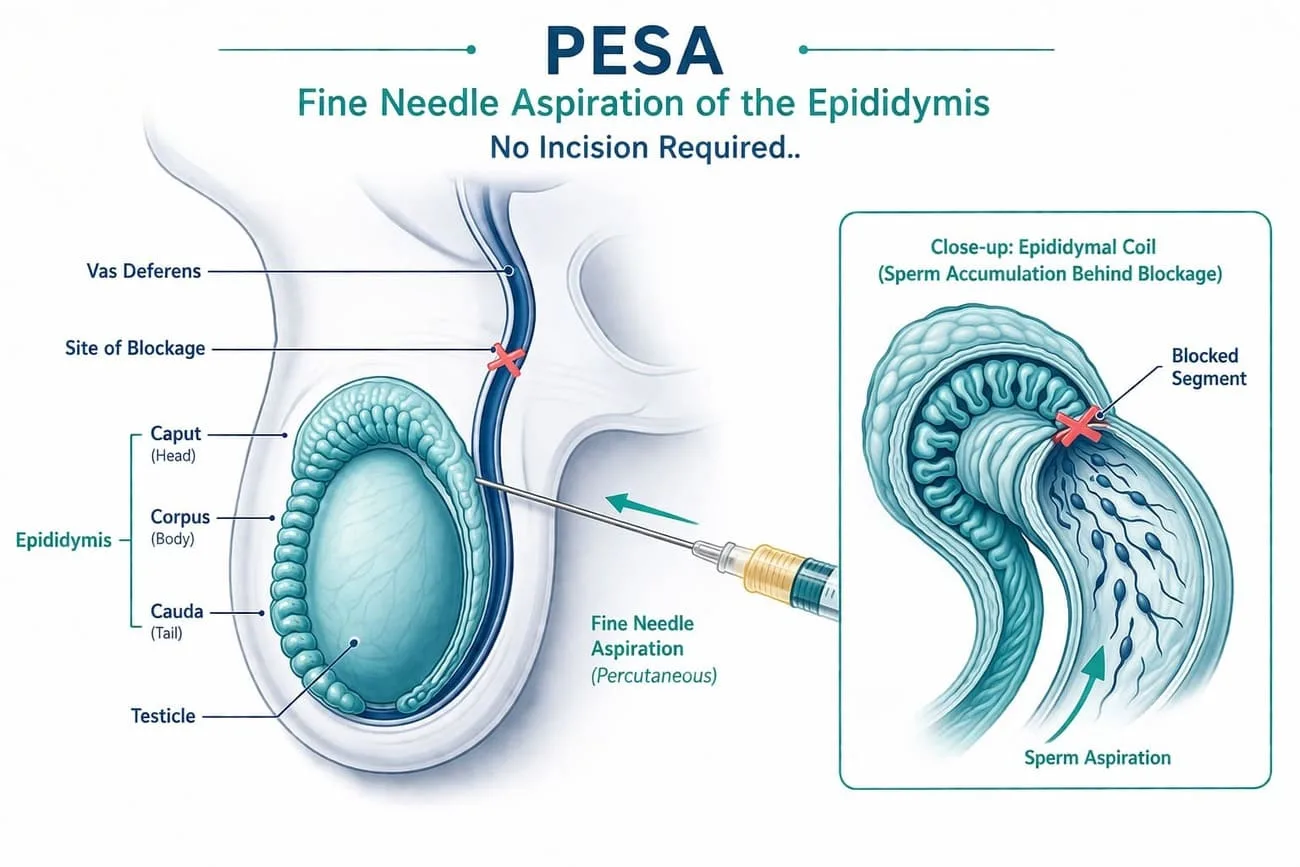
Precision Targeting of Sperm Reservoirs
The male reproductive system stores and matures sperm along a continuous pathway from the seminiferous tubules in the testicles into the epididymal coiled duct and vas deferens. When physical blockages prevent natural ejaculation, localized aspiration captures fully viable, mature spermatozoa.
- Caput / Corpus Epididymis: High concentration of motile sperm in obstructive cases.
- Testicular Tubules: Immature spermatozoa isolated and activated in cleanroom culture.
- No Stitches / Scars: Truly percutaneous micro-needle procedure.
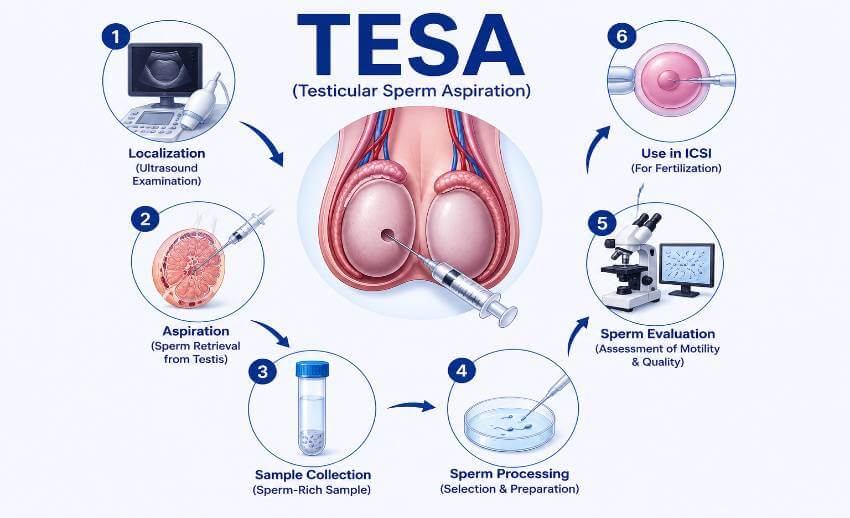
Immediate In-Lab Embryological Search
During the TESA or PESA procedure, the retrieved fluid or micro-biopsy sample is immediately transferred to our in-house cleanroom andrology station. Under high-magnification inverted optics, our embryologists conduct a real-time microscopic search to confirm the presence of viable, motile spermatozoa.
Once confirmed, the viable sperm are processed, washed of red blood cells and tissue debris, and immediately utilized for same-day ICSI fertilization or cryopreserved for future transfer cycles.
Surgical Technique Comparison Matrix
Understanding the distinctions between surgical retrieval methodologies helps in determining the most effective protocol:
| Feature | PESA | TESA | Micro-TESE |
|---|---|---|---|
| Target Site | Epididymal Lumen | Testicular Tubules | Focal Seminiferous Tubules |
| Primary Indication | Obstructive Azoospermia (CBAVD, Vasectomy) | Non-obstructive / Failed PESA | Severe Non-Obstructive Azoospermia |
| Incision / Needle | 28G Butterfly Needle (No incision) | 21G to 23G Fine Needle (No incision) | Micro-incision under 20x Operating Scope |
| Anesthesia | Local Anesthesia | Local Anesthesia | Sedation / General Anesthesia |
| Duration | 10 to 15 Minutes | 15 to 20 Minutes | 60 to 90 Minutes |
| Recovery | Immediate discharge, same-day routine | Same-day discharge, 24 hr rest | 48 hr resting, minimal soreness |
Step-by-Step Surgical Retrieval Protocols
Precision outpatient protocols performed under gentle local anesthesia:
The TESA Protocol
Evaluation of FSH, LH, and Testosterone levels, paired with scrotal Doppler ultrasound to confirm testicular vascularity.
Under local anesthesia, a sterile fine needle gently samples testicular seminiferous tissue without open cuts or sutures.
Embryologists isolate viable spermatozoa and directly micro-inject each mature egg harvested from the partner.
The PESA Protocol
Clinical assessment confirming mechanical obstruction in the vas deferens while verifying normal testicular spermatogenesis.
A micro-fine butterfly needle gently draws epididymal fluid under local numbing, completely pain-free within 10 minutes.
Sperm are washed, quantified for motility, and either fertilized immediately or vitrified for future cycles.
Clinical Sperm Retrieval Benchmarks
Frequently Asked Questions About TESA & PESA
Medically verified answers to common questions regarding surgical sperm retrieval: